


Manuals, Guides, and Videos
The Ultimate Guide to Home Theater Setup
Achieving great sound in a home entertainment system is inherently more complex than with stereo systems, because there are six to twelve (or more) speakers to set up, rather than just two. No matter what speaker configuration you choose, our guide to home theater surround sound setup will help you place and configure your speakers for the best possible sound. Guide: blog.fluance.com/home-theater-setup-guide
|
Signature Series Passive Speakers |
|
|
Reference Series Passive Speakers |
|

First Time Set Up
Selecting An Amplifier For Your Speakers
- Stereo or Surround
- For a two channel setup such as a turntable, a stereo amplifier is ideal. Stereo amplifiers often have higher power output than surround sound receivers because they only have to power two speakers.
- Surround sound receivers offer flexibility with numerous connections and and speaker outputs but may be limited in power output.
-
Power Output
- Each speaker will have a power handling specification. It is best to use an amplifier that can provide more power than the speakers power handling range. This prevents the amplifier from overworking itself which can cause clipping and push the amplifier into protection mode.
-
Impedance
- Impedance is the measurement of resistance in the speaker wiring.
- Amplifiers can output more power with 4 Ohms speakers but it will increase the strain on the amplifier
- Fluance speakers are 4 to 8 Ohms compatible.
- Inputs
- Amplifiers and surround sound receivers often have several different inputs, what you choose will depend on what you plan to connect to the amplifier.
- Phono In: This connection has a phono preamp built in for use with turntables. If you have an external preamp, or your turntable has its own built in preamp, do not use this connection.
Connecting Your Speakers To Your Amplifier
Standard Speaker Wire:
Passive speakers connect to your amplifier with speaker wire, we recommend a minimum of 18 AWG wire.

12AWG Speaker Wire, Oxygen-free Copper Cable - 50ft
-
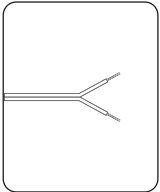
Cut insulation of lead wire to reveal 0.39 - 0.78 inches (1-2cm) of exposed wire on both ends.
-
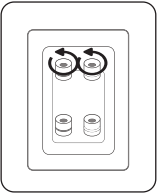
Rotate the positive and negative terminal on the back of the speaker counter clockwise to unlock.
-
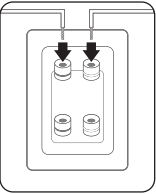
Insert positive/negative end of exposed wire into unlocked positive/negative terminal of speaker.
-
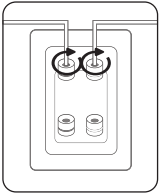
Rotate the positive and negative terminals clockwise to lock exposed wire into terminal.
-
Insert the positive/negative exposed wire of other end into the positive/negative terminal of receiver/amplifier.
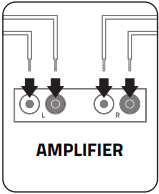
Banana Plug Method:
Note: Banana plugs may not insert fully into speaker binding posts. The binding post will compress the plug to hold it in place.

High-Fidelity 12 Gauge Speaker Wire with Dual Gold-Plated Banana Plugs

Banana Plug, Double Screwed 24K Gold-Plated Color-Coded Connectors
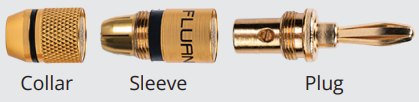
- Remove the Collar from the Sleeve and install on speaker wire.
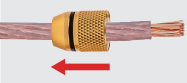
-
Loosen and remove the Plug from the Sleeve and install the Sleeve onto the speaker wire.
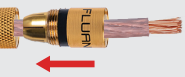
- Loosen the screws on the Plug and insert 1/2 inch of stripped wire into the Plug.
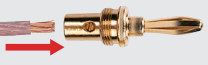
- Firmly tighten the screws onto the wire.
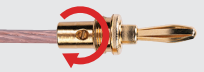
- Install the Sleeve onto the Plug, rotating until fully tightened.
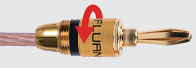
- Install the Collar onto the Sleeve, rotating until fully tightened.
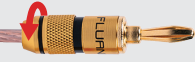
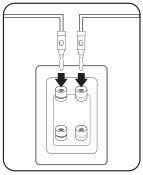
- Insert the positive and negative banana plugs into the matching terminals on the back of the speaker.
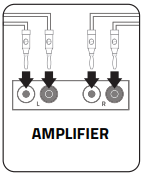
- Insert the positive and negative banana plugs into the matching terminals on the back of the amplifier/receiver.
Connecting a Turntable To Your Passive Speakers
To connect passive speakers to a turntable additional electronics are needed. The standard configuration includes the turntable, a phono preamplifier, an amplifier, and a pair of passive speakers.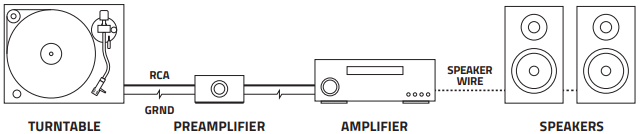
The connected turntable may feature an internal preamplifier. The built-in preamplifier should be disabled or bypassed if using an external preamplifier or a receiver with a built-in preamplifier.
Grounding:
All components in a turntable setup should be properly grounded. Connect
a ground wire from your turntable to your preamplifier and then to your
amplifier. This will prevent unwanted interference or humming during playback.
Placement:
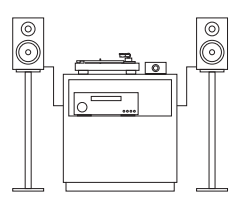
Incorrect speaker placement can cause unwanted feedback on turntable setups. To avoid feedback follow the below recommendations:
- Bookshelf speakers should not be on the same surface as the turntable.
- The speakers can also be placed on speaker stands or speaker isolation pads.
- The turntable should be on a solid and sturdy surface.
Frequently Asked Questions
What is the break-in period for Fluance speakers?
The break-in period for our speakers is a minimum 10-12 hours of playing time at normal listening volumes. After this period the drivers will have had enough movement to perform at their peak level. Do I need Banana Plugs for my Fluance speakers?
What Receiver should I use with Fluance speakers?
In order to get truly Serious Performance™ from your Fluance Speakers, they must be paired up with a Home Theater Receiver capable of equally Serious Performance. With that in mind, the brand names most often used by Fluance customers are: Denon, Marantz, Onkyo, Yamaha.
Why is 18-Gauge Speaker Wire recommended?
At Fluance, we recommend that you use 18-gauge speaker wire when setting up your Home Theater System. We recommend 18-gauge because the larger amount of copper provides less resistance for electricity. A larger gauge (a thinner wire with less copper) can result in power loss, which in turn means lower sound quality and lesser performance from your Home Theater System.
Troubleshooting
Audio Distorted
-
Too much or too little power from amplifier/receiver.
-
Lower the volume and adjust equalizer settings to avoid excessive bass.
Buzzing/Crackling
-
Check cable connections at the receiver and speaker binding posts.
-
Plug the receiver directly into a wall. Where possible use a different outlet.
-
Try different audio sources (TV, Smartphone, Gaming Console, Blu-ray/DVD player).
Muddy/Muffled Bass
-
Speakers are not broken in. Allow a minimum 10 hours of regular use for proper break-in.
-
Speakers/Subwoofer too close to walls. Allow 2-3 feet behind speakers for proper airflow.
- Adjust equalizer settings on the receiver.
No or Limited Bass
-
Check cable connections at the receiver and speaker binding posts.
-
Tower speakers with two sets of binding posts use bridge pins or plates to connect the top and bottom posts when you are not bi-amping. If these are missing, only one set of drivers will work.
-
Change channel settings on the receiver. If a subwoofer is enabled on the receiver without one connected, the bass frequencies will not come through the front speakers.
General Speaker Troubleshooting
-
Confirm the speaker wires are connected to the matching binding posts (Black to Black, Red to Red).
-
Check that the speaker wire is in good condition.
-
Speaker wire should be 18 AWG (American Wire Gauge) or better.
-
Ensure the binding posts are fully tightened.
-
If using speakers with multiple binding posts on back, confirm the metal bridge pins/plates are in place.
-
Compare the amplifier power output to the speaker power handling to ensure they match.
-
Eliminate any audio equalizers or filters that may affect audio output.